OET Writing Tips for Nurses: How to Score Grade B
Last updated: August 31, 2026
1,967+
Students Taught
Band 5.5 → 7+
Typical Score Improvement
16+ Years
Teaching Experience
OET writing tips for nurses usually start in the wrong place: grammar. But OET Writing is not a test of advanced English — it’s a test of clear, professional, purpose-driven communication in a referral or discharge letter. Most Pakistani nurses preparing for OET lose marks on fixable issues — information selection, tone, and structure — not language ability. This guide breaks down exactly what the OET Writing sub-test checks, the letter types you’ll be asked to write, a structure template that works every time, the mistakes that quietly cap nurses at Grade C, and practice prompts you can start using today.

What the OET Writing Sub-Test Actually Tests
The OET Writing sub-test gives you 45 minutes (5 minutes reading time plus 40 minutes writing) to turn a set of case notes into a formal letter — almost always a referral or discharge letter written from a nurse to another healthcare professional. Unlike IELTS or PTE Writing, there’s no generic essay prompt. Every task is profession-specific, built around a real clinical scenario.
Examiners score your letter against six criteria: Purpose, Content, Conciseness and Clarity, Genre and Style, Organisation and Layout, and Language (grammar, cohesion, vocabulary, spelling). Grade B — the score most nursing councils require — needs solid performance across all six, not just clean grammar. This is exactly why so many strong English speakers still score Grade C on OET Writing: they write accurately but include the wrong information, or the letter reads like a case note instead of a professional referral.
Understanding this distinction is the single biggest mindset shift in OET writing preparation for nurses — you’re not writing to show off vocabulary, you’re writing to help another clinician act quickly and correctly.
The Letter Types Nurses Are Asked to Write
OET Writing prompts for nurses rotate through a small set of letter types, and recognising which one you’ve been given in the first 60 seconds saves you from writing the wrong structure under time pressure.
- Referral letter — the most common OET writing task. Written from a ward, clinic, or GP setting to a specialist or another facility, requesting assessment or ongoing care.
- Discharge letter/summary — written when a patient leaves hospital, summarising admission, treatment, and follow-up needs for the GP or receiving facility.
- Letter of transfer — used when a patient moves between wards, hospitals, or care settings, focusing on continuity of care.
- Letter to a carer or relative — less clinical in tone, written in plain, accessible language rather than professional jargon.
Each type has a slightly different purpose, and your opening line should state that purpose immediately — examiners decide a lot about your Purpose and Genre score within the first two sentences.
The OET Letter Structure Template That Works Every Time
Regardless of letter type, this four-part structure consistently scores well in OET writing for nurses:
| Paragraph | Purpose | Approx. Words |
|---|---|---|
| Opening | Patient identification + clear purpose of the letter | 25–35 |
| Body 1 | Relevant medical history and background, organised chronologically or by relevance | 60–80 |
| Body 2 | Current presentation, treatment given, and reason for referral/discharge | 60–80 |
| Closing | Specific action requested + professional sign-off | 25–35 |
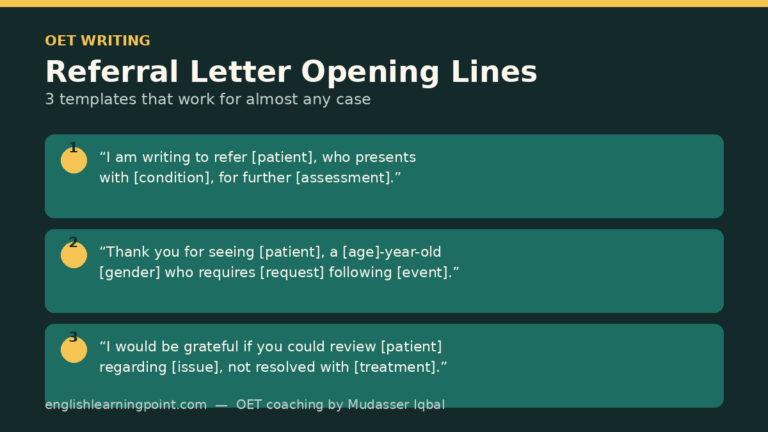
A strong opening line formula: “I am writing to refer [patient name], a [age]-year-old [gender], who presents with [main issue], for further assessment and management.” This single sentence covers purpose and patient identification at once — exactly what OET Writing examiners are scanning for first.
Keep body paragraphs tightly organised around what the receiving professional actually needs to act — not everything in the case notes.
Common OET Writing Mistakes Pakistani Nurses Make
After reviewing hundreds of OET writing attempts from Pakistani nurses, the same five issues show up repeatedly:
- Copying case notes directly. Case notes are fragmented and abbreviated; letters must be full, connected sentences. Transform, don’t transcribe.
- Including everything. Over-inclusion is the single biggest cause of Grade C scores. Select only clinically relevant information for the specific purpose of the letter.
- Urdu-influenced sentence patterns. Literal translation habits (missing articles, inconsistent tense, indirect phrasing) creep into formal writing under time pressure — practice noticing these patterns in your own drafts.
- Wrong tone or register. Either too casual (spoken-style phrasing) or over-formal with unnecessary jargon — aim for clear, courteous, professional.
- Vague closing requests. “Please advise” with no specifics leaves the receiving professional unsure what action to take. Be precise about what you’re asking for.
Practice Exercises with Sample Prompts
Use these two mini-prompts to practice the structure above under timed conditions (aim for 40 minutes each):
Prompt 1 — Referral: A 58-year-old male patient with poorly controlled type 2 diabetes and a new foot ulcer needs referral from your ward to a podiatry/wound care specialist. Include relevant history, current wound status, and the specific assessment requested.
Prompt 2 — Discharge: A 72-year-old female patient is being discharged after a hip fracture repair and needs a discharge letter to her GP covering surgery details, mobility status, and follow-up care instructions.
After each attempt, self-check against this rubric: Does the opening state purpose within the first sentence? Is every detail in the body relevant to the letter’s purpose? Is the tone consistently professional? Is the closing request specific? Practicing one timed letter every 2–3 days with honest self-review against this rubric is enough to move most nurses from Grade C to Grade B within a few weeks.
The fastest way to improve your OET writing score is with feedback on exactly what to cut and keep — book OET writing feedback or join the OET batch.
Keep going
Want feedback on your actual writing? Join a live batch and get every task marked personally. Or browse more free IELTS, PTE, TOEFL & OET study guides.
More OET Guides
Explore the full OET Guides & Resources hub, or continue with these related guides: