OET Discharge Letter Sample for Nurses: Full Example, Band-by-Band Annotation & Common Mistakes
Last updated: September 14, 2026
1,967+
Students Taught
Band 5.5 → 7+
Typical Score Improvement
16+ Years
Teaching Experience

This OET discharge letter sample for nurses shows exactly what examiners score. A strong OET discharge letter for nurses gets straight to the point: it tells the receiving clinician (usually a GP or community nurse) exactly what happened, what matters now, and what to do next — in under 200 words, with zero jargon a general practitioner wouldn’t use. Below is a full Grade A-standard example, broken down line by line against the four OET writing criteria, plus a second example and the mistakes that most often cost Pakistani nurses marks.
What the OET discharge letter task actually asks for
The OET Writing sub-test (nursing) gives you a set of case notes — patient details, admission reason, treatment given, current status — and asks you to write a letter, usually to a GP or a receiving facility, transferring care. You get 45 minutes: 5 minutes reading time, 40 minutes writing. The letter itself should run roughly 180-200 words. Anything much longer usually means you’re including case-note detail the reader doesn’t need — which the "Appropriateness of Language" criterion actively penalises.
Case notes (example)
Patient: Mrs. Angela Collins, 68 years old
Admitted: 3 days ago via Emergency Department
Diagnosis: Community-acquired pneumonia, right lower lobe
Treatment: IV co-amoxiclav 1.2g TDS for 48 hours, switched to oral amoxicillin 500mg TDS on Day 3
Observations on discharge: Afebrile 24 hours, SpO2 96% on room air, RR 18, HR 82
Relevant history: Type 2 diabetes (metformin 500mg BD), mild COPD
Social: Lives alone, daughter visits twice weekly
Discharge plan: Complete 5-day course oral amoxicillin, GP review in 1 week, chest X-ray in 6 weeks to confirm resolution, diabetes review at same GP visit
Sample letter — Band A standard
Dear Doctor,
Re: Mrs. Angela Collins, DOB [xx/xx/xxxx]
I am writing to inform you that Mrs. Collins, a 68-year-old woman with type 2 diabetes and mild COPD, was discharged from our care today following a 3-day admission for community-acquired pneumonia.
On admission, she presented with fever, productive cough, and reduced oxygen saturation. Chest X-ray confirmed right lower lobe consolidation. She was commenced on intravenous co-amoxiclav, which was switched to oral amoxicillin on Day 3 once she showed clinical improvement.
At discharge, Mrs. Collins is afebrile, saturating at 96% on room air, and clinically stable. She has been provided with a 5-day course of oral amoxicillin 500mg three times daily, which she should complete in full.
I would be grateful if you could review her in one week to confirm ongoing recovery, and arrange a chest X-ray in six weeks to ensure full resolution. As she lives alone, with her daughter visiting twice weekly, please also consider whether any additional support would benefit her during recovery.
Her diabetes remains well controlled on metformin; no changes were required during this admission, though a routine diabetes review at her follow-up appointment would be appropriate.
Please do not hesitate to contact the ward if you require further information.
Yours sincerely,
[Nurse name], Registered Nurse
(198 words — within the target range)
Examiner-style annotation: why this letter scores well
Overall Task Fulfilment (does it cover everything the reader needs, and nothing they don’t?)
Every clinically necessary fact from the case notes appears — diagnosis, treatment given, current status, follow-up plan — but nothing extraneous. Note what’s left out: the exact admission time, the ED triage category, and the nurse’s own observations chart. A GP doesn’t need those to manage this patient going forward; including them would cost marks for irrelevant detail, not earn them for thoroughness.
Appropriateness of Language (register, tone, is it written for the right reader?)
The letter is written GP-to-GP, not nurse-to-nurse — "commenced on intravenous co-amoxiclav" rather than "started IV augmentin," full drug names rather than ward shorthand. The closing paragraph on social support is a habit examiners specifically reward: it shows clinical judgement beyond just reporting facts, which is what "nursing" writing (as opposed to a generic summary) is actually testing.
Comprehension of Stimulus (accuracy against the case notes)
Every figure matches the case notes exactly — SpO2 96%, HR and RR omitted deliberately because they’re normal and not clinically actionable for the GP, which is itself a comprehension judgement, not an oversight. A common band-6 mistake is copying every observation from the case notes regardless of relevance; a band-8 letter selects.
Linguistic Features (grammar, cohesion, spelling, punctuation)
Note the connective structure: "On admission… At discharge… I would be grateful if…" — each paragraph has one clear job (history → treatment → current status → plan → additional note), which is what markers mean by "logical organisation." Sentence length varies deliberately; a letter built entirely of short, choppy sentences reads as underdeveloped even when the grammar is technically correct.
A second complete example — referral letter
Case notes: Mr. Harold James, 74, referred from general ward to community physiotherapy following a fall with no fracture, mild deconditioning, lives with wife who has limited mobility herself.
Dear Colleague,
Re: Mr. Harold James, DOB [xx/xx/xxxx]
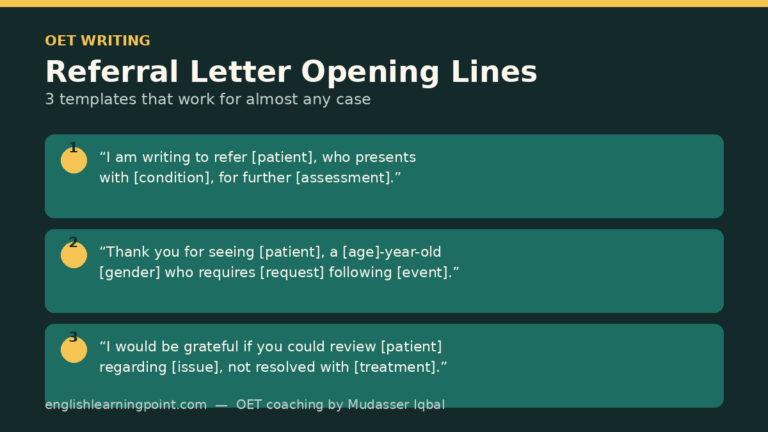
I am referring Mr. James, a 74-year-old man, for community physiotherapy assessment following a mechanical fall at home last week.
He was admitted for observation after the fall; X-rays excluded fracture, and no acute injury was identified. However, he has shown some generalised deconditioning during his 4-day stay, with reduced mobility and confidence walking unaided.
Prior to admission he was independently mobile, though he lives with his wife, who has limited mobility herself and is unable to assist him physically. I would therefore be grateful if you could arrange a home visit to assess his mobility, gait, and fall risk, and advise on any equipment or home modifications that may help.
He remains medically stable and is keen to regain his previous level of independence.
Please contact the ward if any further information would be helpful.
Yours sincerely,
[Nurse name], Registered Nurse
(160 words)
This example is intentionally shorter to show the same discipline scaling down — even a lower-complexity case doesn’t need padding to reach 180-200 words if there simply isn’t more clinically relevant material to include.
The three mistakes that cost Pakistani OET candidates the most marks
- Copying case-note phrasing verbatim instead of writing in full sentences. Case notes are written in clinical shorthand on purpose (fast to record on a ward); a letter is a different genre. "Pt afebrile, SpO2 96% RA" needs to become "she is afebrile, with oxygen saturation of 96% on room air," — examiners mark this under Linguistic Features even though the facts are identical.
- Writing to the wrong register. Some candidates default to a very formal, almost legal tone; others write too casually, as if messaging a colleague on the ward. GP-to-GP register sits in between — professional but direct, with contractions avoided but jargon kept to clinically standard terms.
- Running over or under the word count by including or omitting the wrong things. Going over 200 words is almost always a sign of including case-note detail that isn’t clinically relevant to the reader; going well under 180 usually means a genuinely important detail (follow-up plan, safety-netting advice) got dropped.
Frequently asked questions
How long should an OET discharge letter be?
Roughly 180-200 words. There’s no hard cap enforced by the exam, but letters significantly over 200 words are almost always including irrelevant case-note detail, which costs marks under Task Fulfilment rather than earning them for completeness.
Do I need to use every piece of information in the case notes?
No — and including everything is one of the most common mistakes. The task is testing your judgement about what the receiving clinician actually needs, not your ability to transcribe the case notes in full.
What’s the difference between a discharge letter and a referral letter in OET Writing?
A discharge letter closes the loop on an episode of care and hands ongoing management back to the GP or another provider. A referral letter requests a specific action from a specific service (like the physiotherapy example above). The structure is similar, but a referral letter needs a clear, explicit request near the top or middle of the letter — what exactly you’re asking the reader to do.
Is it okay to use medical abbreviations in an OET letter?
Widely-recognised abbreviations that a GP would use themselves (like SpO2, IV, BD/TDS for dosing) are fine. Ward-specific shorthand or abbreviations that assume nursing-specific context are not — if in doubt, write it out in full.
Prepared personally as part of English Learning Point’s OET coaching — every Writing task submitted by ELP students is marked by hand, band by band, the same way this sample is annotated above.
Book a free OET writing assessment on WhatsApp: 0300-6107060
Related OET Resources
- OET Transfer Letter Sample for Nurses — for when care is continuing to a different facility, not closing out
- OET Speaking Role-Play Examples — sample role-plays for nurses, doctors, and pharmacists
- OET Reading Part B & C Practice — full practice set with answer explanations
More OET Guides
Explore the full OET Guides & Resources hub, or continue with these related guides: