PTE Reorder Paragraphs: 5 Proven Techniques
Last updated: August 26, 2026
1,967+
Students Taught
Band 5.5 → 7+
Typical Score Improvement
16+ Years
Teaching Experience
PTE Reorder Paragraphs gives you a jumbled set of sentences and about a minute to rebuild them into a logical paragraph — and most test-takers lose marks not because they can’t read, but because they judge each sentence in isolation instead of using the structural clues that link them. Here are five techniques for PTE Reorder Paragraphs that consistently find the correct order, plus the mistake that costs the most points.
What the Reorder Paragraphs Task Actually Tests
PTE Reorder Paragraphs sits inside the Reading section and scores on cohesion, not vocabulary. You’re not being tested on whether you understand each sentence — you’re being tested on whether you can trace how sentences connect to each other through pronouns, linking words, and logical sequence. Scoring is partial: PTE awards points for each correctly ordered adjacent pair, so even a partially correct sequence earns marks.
5 Techniques for PTE Reorder Paragraphs That Actually Work
These five techniques for PTE Reorder Paragraphs work on almost any jumbled set, regardless of topic:
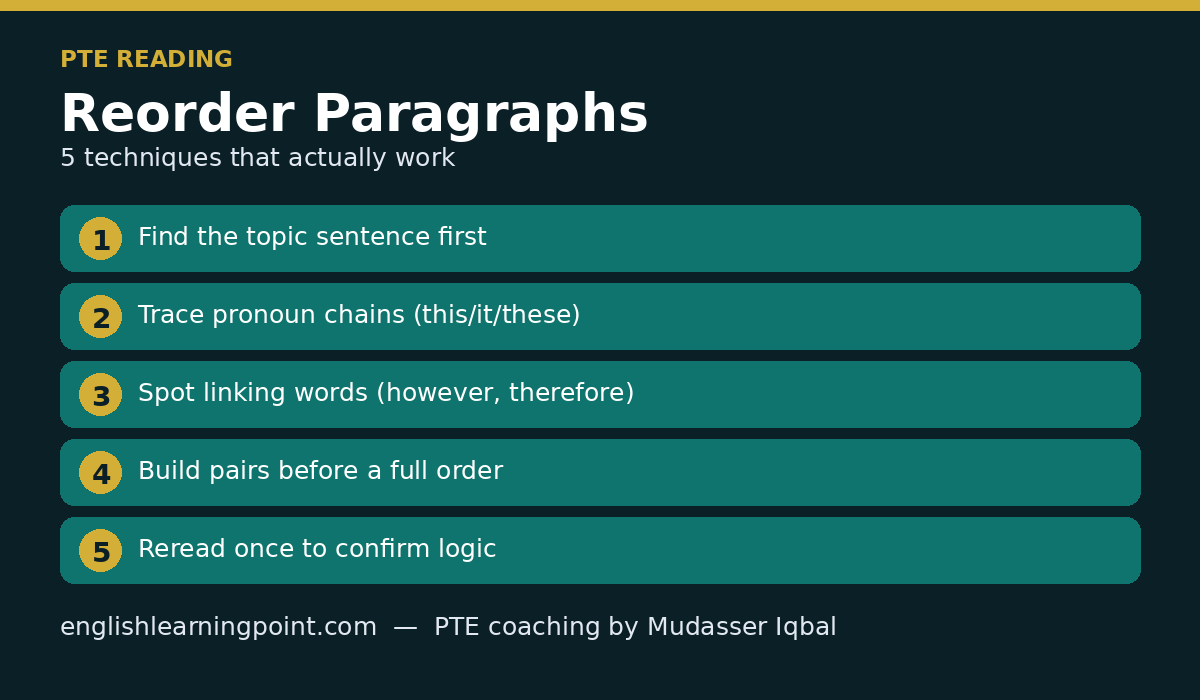
- Find the topic sentence first. The opening sentence introduces the subject in general terms and never starts with a pronoun like “this,” “it,” or “these” — those need something earlier to refer to.
- Trace pronoun chains. Every “this,” “it,” “these,” or “such” must point back to a noun in an earlier sentence. Match the pronoun to its noun and you’ve found a pair.
- Spot linking words. Words like “however,” “therefore,” “in addition,” and “as a result” signal what kind of sentence comes next — contrast, consequence, or continuation.
- Build pairs before forcing a full order. Don’t try to solve the whole paragraph at once. Find two or three confident pairs first, then chain them together.
- Reread once to confirm logic. Once you have a full order, read it top to bottom in five seconds — a correct sequence should read like a normal paragraph, not a puzzle.
The Most Common Mistake in PTE Reorder Paragraphs
The biggest mistake in PTE Reorder Paragraphs is reading each sentence for meaning in isolation and guessing an order based on which ideas “feel” related, instead of tracing the actual discourse markers. Two sentences can be topically related without being adjacent — the exam is testing textual cohesion, not topic clustering. If you can’t point to a specific pronoun or linking word that connects two sentences, don’t place them next to each other.
A Step-by-Step Approach for the Actual Test
With roughly a minute per item, a fixed process beats re-reading randomly:
- Skim all the sentences once, quickly, without trying to order anything yet.
- Identify the likely first sentence — the one with no pronoun referring backward.
- Build two or three pairs using pronoun and linking-word clues.
- Chain the pairs into a full sequence.
- Reread the final order once to confirm it flows logically before moving on.
Quick FAQ
How many Reorder Paragraphs questions are on the PTE?
Typically two to three questions appear in the Reading section, though the exact number can vary slightly between test forms.
Is PTE Reorder Paragraphs scored as all-or-nothing?
No. PTE awards partial credit for each correctly placed adjacent pair, so getting three sentences in the right relative order still earns marks even if the full paragraph isn’t perfect.
Do templates work for PTE Reorder Paragraphs?
Not the way they work for Speaking or Writing tasks. Reorder Paragraphs is a logic and cohesion skill applied to new content every time, so there’s no script to memorise — only the techniques above, applied consistently. See our take on whether PTE templates still work in 2026 for where templates do and don’t help.
For the official task format and scoring breakdown, Pearson’s PTE Academic overview covers how Reading items are weighted.
Want feedback on exactly which reading tasks are costing you marks? Message us on WhatsApp or see the full PTE Online Classes schedule — targeted practice on Reorder Paragraphs, not generic reading drills.
Practicing PTE Reorder Paragraphs the Right Way
Most students practicing PTE Reorder Paragraphs make the mistake of treating every attempt the same way, regardless of how they did on the last one. A more effective approach is to categorize each practice paragraph by why you got it wrong: was it a pronoun reference you missed, a logical connector you misread, or a topic sentence you failed to identify? Tracking this over 30 to 40 practice sets reveals a pattern — most students have one or two specific weaknesses driving the majority of their errors, and once you know which one it is, targeted practice closes the gap far faster than generic repetition.
Time pressure is another factor students underestimate. On the real PTE exam, Reorder Paragraphs questions appear within a fixed overall time budget for the Reading section, so practicing without a timer builds false confidence. Once your accuracy on untimed practice reaches a consistent 80% or higher, switch to timed drills that simulate the actual exam pressure, since the skill of reordering quickly under pressure is different from the skill of reordering correctly with unlimited time.
Why Native-Language Reading Habits Cause Errors
Pakistani candidates whose first language uses different discourse markers than English often misread transition words in Reorder Paragraphs passages, because the logical relationship they expect (cause-effect, contrast, addition) doesn’t map cleanly onto English connectors like “however,” “consequently,” or “in addition.” Building explicit familiarity with how English paragraphs typically open (general statement), develop (supporting detail), and close (conclusion or transition) helps override this instinct and read the passage the way the test expects, rather than the way your first language trained you to read.
ELP’s PTE Reading sessions include dedicated Reorder Paragraphs drills built specifically around these common failure patterns, with error-type tracking so students know exactly what to fix rather than guessing. Message us on WhatsApp to book a diagnostic session and find out which pattern is holding your score back.
More PTE Guides
Explore the full PTE Guides & Resources hub, or continue with these related guides: