OET Exam Guide for Nurses in Pakistan
This OET exam guide for nurses in Pakistan covers what OET is, section-by-section breakdown, OET vs IELTS, registration and fees, and a realistic study plan for working nurses — your complete starting point for OET preparation.

What Is OET and Why Pakistani Nurses Take It
OET (Occupational English Test) is a healthcare-specific English test built around real clinical scenarios, which is why nursing councils in the UK, Australia, New Zealand, and Ireland often prefer or accept it over general English tests. OET has four sub-tests — Listening, Reading, Writing, and Speaking — each graded on an A–E scale, with most nursing registration bodies requiring a minimum of Grade B across all four sub-tests.
Section-by-Section Breakdown for Nurses
Listening and Reading use healthcare-context material — patient consultations, staff meetings, and clinical case studies — so building medical vocabulary alongside general English practice pays off.
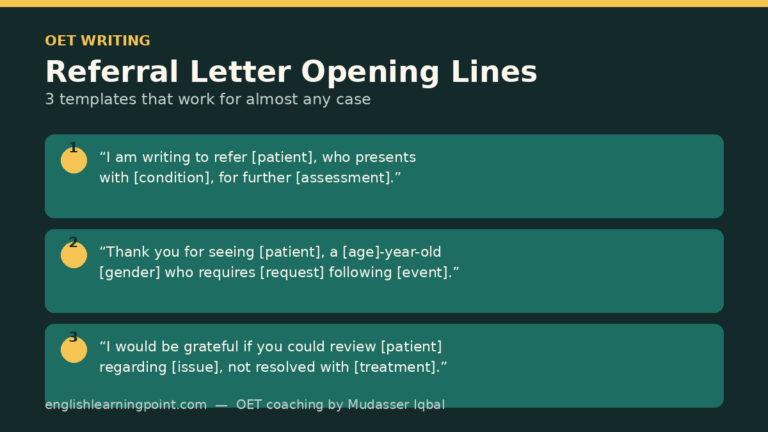
Writing is the referral or discharge letter task most nurses find hardest. For a full breakdown of structure, letter types, and common mistakes, see our dedicated OET writing tips for nurses guide, plus our deep-dive on referral letter opening lines that actually work.
Speaking uses a role-play format simulating real nurse-patient interactions, assessed on clinical communication skills like empathy, clarity, and appropriate questioning — not just grammar.
OET vs IELTS for Nurses — Which to Choose
Many Pakistani nurses default to IELTS without realising OET may be the better fit for a healthcare career specifically, since its content is directly relevant to clinical work rather than generic academic topics. See our full OET vs IELTS for nurses going to the UK comparison to decide which test your target country and registration body actually requires.
Registration, Fees & Test Centers in Pakistan
OET is booked directly through the official OET website; confirm current fees and Pakistani test centre availability there, since pricing and locations can change. Results are typically available within about 16 business days. Always verify your registration body’s exact score requirement (commonly Grade B, sometimes with a minimum sub-grade per section) before booking, since requirements vary by country and nursing council.
Study Plan, Resources & Grade B Strategy
Most working nurses need a realistic, shift-friendly study plan rather than an intensive daily schedule. A sustainable approach: 3–4 focused sessions per week of 45–60 minutes, prioritising Writing (the most commonly failed sub-test) with regular timed practice letters reviewed against a structured rubric.
What’s the fastest way to reach Grade B in Writing? Practice selecting only clinically relevant information and using the four-part letter structure consistently — see the full template in our OET writing tips guide.
Can I self-study for OET as a working nurse? Yes, with consistent practice and periodic feedback on Writing and Speaking, since these are the two sub-tests hardest to self-grade accurately.
How many times can I retake OET? There’s no limit, but each attempt costs the full registration fee, so building an error log after every mock is worth the time investment.
Explore every OET guide in our OET category, or compare with OET vs IELTS for nurses if you’re still deciding which test to take.
Ready to act on this?
Keep going
Want feedback on your actual writing? Join a live batch and get every task marked personally. Or browse more free IELTS, PTE, TOEFL & OET study guides.